
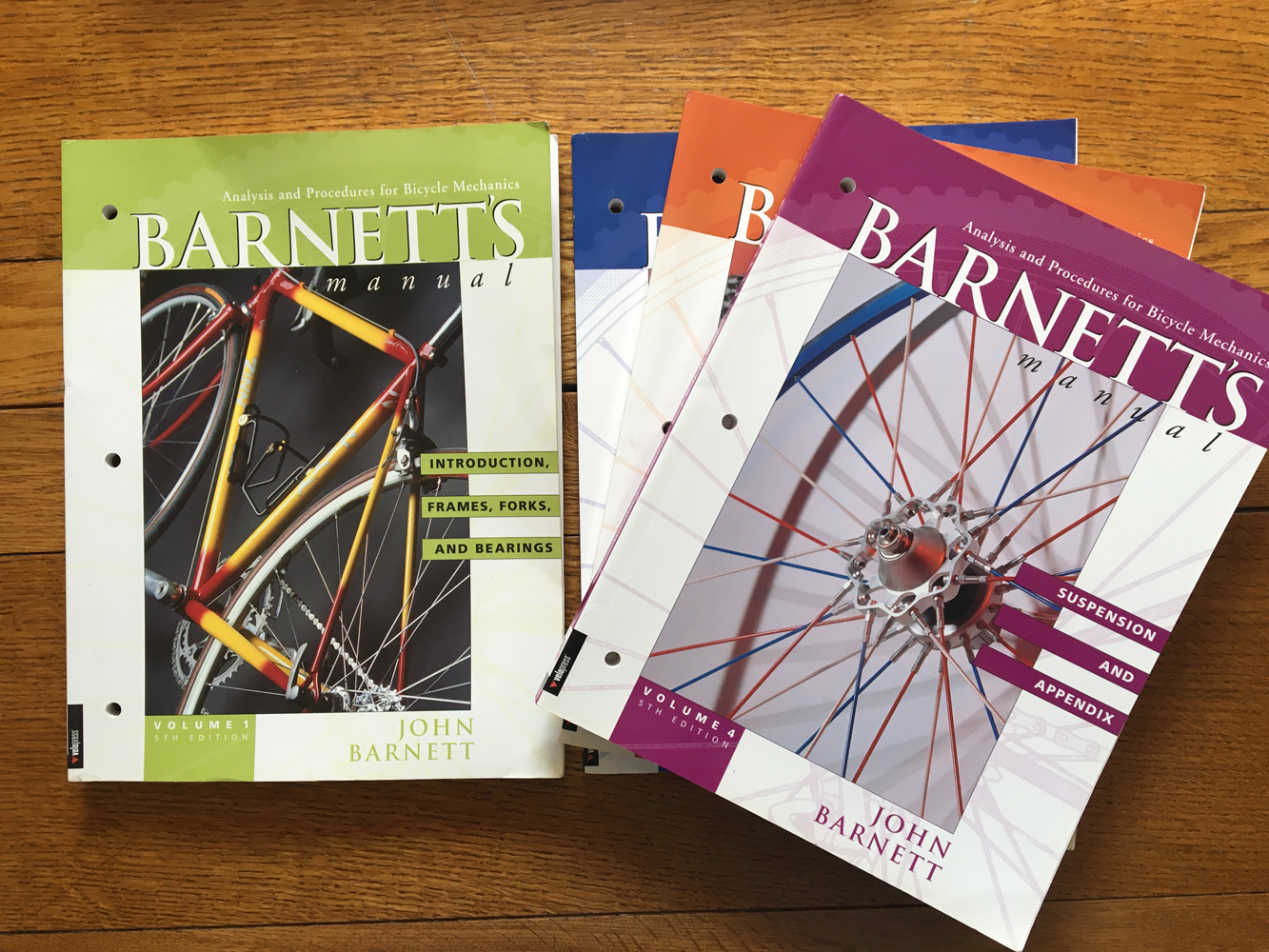
The Central Alberta Bicycle Society (CABS) is retaining the Barnett Manual (5th Edition) as the primary textbook for our Professional Bicycle Mechanics Program. Quality Bicycle Products (Minneapolis, MN) — the publisher and copyright holder of the Barnett Manual — has ceased publishing and distributing the manual to the general public and, following closure of their mechanics school UofQ due to business impacts from the COVID‑19 pandemic, no longer sells the manual. That change prompted CABS to reevaluate the Barnett Manual’s role in our curriculum. The forthcoming Position Statement reports our decision to retain the Barnett Manual as the primary text and outlines the rationale and implications for students and instructors.
CABS Position Statement: Adoption and Retention of Barnett’s Manual (5th Edition) as the Primary Text for the CABS Professional Bicycle Mechanics Program
Position
The Central Alberta Bicycle School (CABS) adopts Barnett’s Manual, 5th Edition, as the primary textbook for the CABS Professional Bicycle Mechanics Program. Barnett’s provides the detailed, accurate technical information and science-based approach required to train professional mechanics to a consistently high standard of competency, safety, and repeatability. Other widely used references—such as the Park Tool Manual—are valuable workshop aids but are not sufficient as the principal teaching text for our professional program because they are overly verbose, primarily procedural, and lack the theoretical foundation necessary for advanced, repeatable diagnostics and repair.
Rationale
- Safety and Professional Responsibility: Professional mechanics bear direct responsibility for rider safety and ride quality. Barnett’s emphasis on scientific methods, measurement, and reproducible procedures aligns with CABS’s obligation to graduate mechanics who can reliably deliver safe, high-quality work.
- Theory + Practice: Barnett’s balances meticulous technical detail with underlying theory (materials, tolerances, mechanics, failure modes). This enables students to understand why procedures work, to adapt methods to non-standard problems, and to innovate when faced with new components or failure modes—capabilities not well-supported by purely procedural texts.
- Precision and Repeatability: The program’s assessment standards require measurable, repeatable outcomes (torque values, alignments, tolerances, diagnostic logic). Barnett’s content supports these standards directly; verbose procedural guides without rigorous theoretical grounding do not.
- Consumer and Professional Utility: While Barnett’s also serves self-repairing consumers, its primary utility for CABS is as a professional manual—its thoroughness prepares technicians for complex work beyond basic shop procedures.
Comparison with Common Alternatives
- Park Tool Manual and Similar Procedural Guides: Strengths — practical step-by-step instructions and broad accessibility for hobbyists and busy shops. Limitations for CABS — often verbose, oriented toward tasks rather than principles, and limited in theoretical explanation. These resources are excellent supplements for shop workflows and quick reference, but inadequate as the central curriculum text for a professional training program focused on deep understanding and consistent, measurable competence.
- Barnett’s Manual: Strengths — concise where it must be, comprehensive in technical depth, and focused on scientific approaches and measurement. It equips students with the reasoning skills needed for troubleshooting, quality assurance, and work that must meet regulatory and safety expectations.
Implementation Recommendations
- Primary Text: Adopt Barnett’s Manual (5th Edition) as required reading for core modules: frame and fork geometry and tolerances, wheel and hub systems, drivetrain theory and adjustment, braking systems, bearing technology, and diagnostics.
- Curriculum Integration: Structure lectures around Barnett’s theoretical explanations followed by hands-on instruction that require students to apply measurements, calculate tolerances, and document repeatable procedures.
- Assessment Alignment: Design assessments (practical exams, written diagnostics, troubleshooting scenarios) to test understanding of both theory and reproducible procedure as presented in Barnett’s.
Conclusion
For a professional program whose mandate is to produce safe, competent, and analytically capable bicycle mechanics, Barnett’s Manual (5th Edition) best meets CABS’s needs as the main teaching textbook. Procedural guides like the Park Tool Manual retain value as practical supplements but are insufficient as the curricular foundation because they prioritize verbose procedure over the theoretical rigour and scientific approach central to professional-level training.
Central Alberta Bicycle School (CABS) — Textbook Access Student Advisory
- Barnett’s Manual (5th Edition) and the Barnett’s Manual DX USB stick are out of print. The license holder, Quality Bicycle Products (QBP), is no longer offering these texts to the public.
- For the duration of your CABS program, CABS will provide the digital Barnett’s Manual installed on a loaned Amazon Kindle HD. This is a licensed, temporary loan for course use only.
- Do NOT transfer, copy, extract, or distribute the PDF or any files from the loaned Kindle. Doing so would violate the copyright license and may result in disciplinary action and legal consequences.
- If you wish to obtain your own copies:
- Digital access: purchase eManuals at emanuals.com or subscribe via Scribd at scribd.com.
- Print copies: check listings on eBay at ebay.com for used/print editions.
If you need help purchasing a personal copy or have questions about the Kindle loan agreement, please contact the CABS Administrator or reach out to us through our contact page.

ABOUT THE AUTHOR
Brian Hahn is a fully certified professional bicycle mechanic, a former member of the PBMA, author of the Central Alberta Bicycle School CABS Student Handbook and an instructor of CABS. He has been published in several publications in Canada on varied topics. Over the past nine years he has taught students who achieved both the BAM Certification Program and the Bicycle Building and Wheel Truing Certificate Courses. He can be contacted directly through the CABS Contact Page.